Materiales adsorbentes alternativos para la remoción de contaminantes en agua
DOI:
https://doi.org/10.66482/0v4y9j64Palabras clave:
remoción, redes organometálicas, plaguicidas, medio ambienteResumen
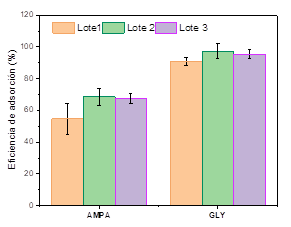
Se estima que el consumo de agua a nivel mundial se duplicará para el año 2050, por lo que la remoción de contaminantes en los compartimentos acuáticos se convierte en una estrategia a corto plazo para contrarrestar los problemas derivados de las sequías y la escasez de agua. Este trabajo aborda factores críticos, perspectivas y limitaciones de un compuesto organometálico a base de hierro en el tratamiento de aguas residuales. El material propuesto fue Fe-MIL-101, obtenido mediante una síntesis asistida por microondas, que redujo el tiempo de síntesis hasta siete veces en comparación con otros adsorbentes. Las propiedades texturales del adsorbente sintetizado se analizaron mediante adsorción-desorción de N₂, lo que permitió una mejor comprensión de los posibles mecanismos sinérgicos de adsorción que mejoran su capacidad para remover contaminantes. Finalmente, se evaluaron las eficiencias de remoción y la reutilización de Fe-MIL-101, mostrando un desempeño prometedor para la remoción de contaminantes emergentes en agua.
Descargas
Referencias
J. M. Galindo-Miranda, C. Guízar-González, E. J. Becerril-Bravo, G. Moeller-Chávez, E. León-Becerril, and R. Vallejo-Rodríguez, “Occurrence of emerging contaminants in environmental surface waters and their analytical methodology - A review,” Water Sci. Technol. Water Supply, vol. 19, no. 7, pp. 1871–1884, 2019. https://doi.org/10.2166/ws.2019.087
I. Vázquez-Tapia et al., “Occurrence of emerging organic contaminants and endocrine disruptors in different water compartments in Mexico – A review,” Chemosphere, vol. 308, pp. 1-12, 2022. https://doi.org/10.1016/j.chemosphere.2022.136285
C. Peña-Guzmán et al., “Emerging pollutants in the urban water cycle in Latin America: A review of the current literature,” J. Environ. Manage., vol. 237, pp. 408–423, 2019. https://doi.org/10.1016/j.jenvman.2019.02.100
P. Drechsel, M. Qadir, and D. Galibourg, “The WHO Guidelines for Safe Wastewater Use in Agriculture: A Review of Implementation Challenges and Possible Solutions in the Global South,” Water, vol. 14, no. 6, pp. 1-20, 2022. https://doi.org/10.3390/w14060864
A. Jodar-Abellan, M. I. López-Ortiz, and J. Melgarejo-Moreno, “Wastewater treatment and water reuse in Spain. Current situation and perspectives,” Water, vol. 11, no. 8, pp. 17–22, 2019. https://doi.org/10.3390/w11081551
T. Rasheed et al., “Environmental threatening concern and efficient removal of pharmaceutically active compounds using metal-organic frameworks as adsorbents,” Environ. Res., vol. 185, p. 109436, 2020. https://doi.org/10.1016/j.envres.2020.109436
S. S. Kaushal et al., “Watershed ‘chemical cocktails’: forming novel elemental combinations in Anthropocene fresh waters,” Biogeochemistry, vol. 141, no. 3, pp. 281–305, 2018. https://doi.org/10.1007/s10533-018-0502-6
H. Kaur, N. Devi, S. S. Siwal, W. F. Alsanie, M. K. Thakur, and V. K. Thakur, “Metal-Organic Framework-Based Materials for Wastewater Treatment: Superior Adsorbent Materials for the Removal of Hazardous Pollutants,” ACS Omega, vol. 8, no. 10, pp. 9004–9030, 2023. https://doi.org/10.1021/acsomega.2c07719
M. Ding, X. Cai, and H. L. Jiang, “Improving MOF stability: Approaches and applications,” Chem. Sci., vol. 10, no. 44, pp. 10209–10230, 2019. https://doi.org/10.1039/c9sc03916c
J. Joseph, S. Iftekhar, V. Srivastava, Z. Fallah, E. N. Zare, and M. Sillanpää, “Iron-based metal-organic framework: Synthesis, structure and current technologies for water reclamation with deep insight into framework integrity,” Chemosphere, vol. 284, pp. 1-35, 2021. https://doi.org/10.1016/j.chemosphere.2021.131171
J. Prado-Jongal and E. Morán, “Síntesis asistida por microondas de sólidos inorgánicos,” Real Sociedad Española de Química, An. Química, vol. 107, no. 2, pp. 129-136, 2011.
M. Nasrollahzadeh, “Biopolymer-based metal nanoparticle chemistry for sustainable applications,” India, Elsevier Inc., 2021.
K. Boukayouht, L. Bazzi, and S. El Hankari, “Sustainable synthesis of metal-organic frameworks and their derived materials from organic and inorganic wastes,” Coord. Chem. Rev., vol. 478, p. 214986, 2023. https://doi.org/10.1016/j.ccr.2022.214986
M. Du et al., “Insight into the synthesis and adsorption mechanism of adsorbents for efficient phosphate removal: Exploration from synthesis to modification,” Chem. Eng. J., vol. 442, p. 136147, 2022. https://doi.org/10.1016/J.CEJ.2022.136147
R. S. Forgan, “Reproducibility in research into metal-organic frameworks in nanomedicine,” Commun. Mater., vol. 5, no. 1, pp. 1–5, 2024. https://doi.org/10.1038/s43246-024-00475-7
Q. Yang et al., “The simultaneous detection and removal of organophosphorus pesticides by a novel Zr-MOF based smart adsorbent,” J. Mater. Chem. A, vol. 6, no. 5, pp. 2184–2192, 2018. https://doi.org/10.1039/c7ta08399h
R. yi Zhou, J. xia Yu, and R. an Chi, “Selective removal of phosphate from aqueous solution by MIL-101(Fe)/bagasse composite prepared through bagasse size control,” Environ. Res., vol. 188, no. 693, pp. 1-10, 2020. https://doi.org/10.1016/j.envres.2020.109817
A. Masoumi, K. Hemmati, and M. Ghaemy, “Recognition and selective adsorption of pesticides by superparamagnetic molecularly imprinted polymer nanospheres,” RSC Adv., vol. 6, no. 55, pp. 49401–49410, 2016. https://doi.org/10.1039/c6ra05873f
S. Fiorilli et al., “Iron oxide inside SBA-15 modified with amino groups as reusable adsorbent for highly efficient removal of glyphosate from water,” Appl. Surf. Sci., vol. 411, pp. 457–465, 2017. https://doi.org/10.1016/j.apsusc.2017.03.206
Z. Zhao, B. Liang, M. Wang, Q. Yang, M. Su, and S. Liang, “Microporous carbon derived from hydroxyl functionalized organic network for efficient adsorption of flumequine: Adsorption mechanism and application potentials,” Chem. Eng. J., vol. 427, p. 130943, 2022. https://doi.org/10.1016/j.cej.2021.130943
S. Harabi et al., “Adsorption of Pesticides on Activated Carbons from Peach Stones,” Processes, vol. 12, no. 1, p. 238, 2024. https://doi.org/10.3390/pr12010238
W. Liang, B. Wang, J. Cheng, D. Xiao, Z. Xie, and J. Zhao, “3D, eco-friendly metal-organic frameworks@carbon nanotube aerogels composite materials for removal of pesticides in water,” J. Hazard. Mater., vol. 401, p. 123718, 2021. https://doi.org/10.1016/j.jhazmat.2020.123718
J. Ma et al., “Metal organic frameworks (MOFs) for magnetic solid-phase extraction of pyrazole/pyrrole pesticides in environmental water samples followed by HPLC-DAD determination,” Talanta, vol. 161, pp. 686–692, 2016. https://doi.org/10.1016/j.talanta.2016.09.035
O. Solcova, M. Dlaskova, and F. Kastanek, “Innovative Sorbents for the Removal of Micropollutants from Water,” Molecules, 30, 1444, pp. 1–22, 2025. https://doi.org/10.3390/molecules30071444
R. A. W. Sing, K.S.W., Everet, D. H., Haul, “Reporting Physisorption Data for Gas/Solid Systems with Special Reference to the Determination of Surface Area and Porosity,” Pure Appl. Chem., vol. 57, no. 4, pp. 603–619. 1985.
Descargas
Publicado
Número
Sección
Licencia
Derechos de autor 2025 Revista Ciencia Aplicada

Esta obra está bajo una licencia internacional Creative Commons Atribución-NoComercial-SinDerivadas 4.0.