Polímeros de Impresión Molecular: una alternativa innovadora para la remoción selectiva de As3+ en tratamiento de agua subterránea
DOI:
https://doi.org/10.66482/12aska39Palabras clave:
arsénico trivalente, polímero de impresión molecular, remoción de metales pesados, espectroscopia UV-visResumen
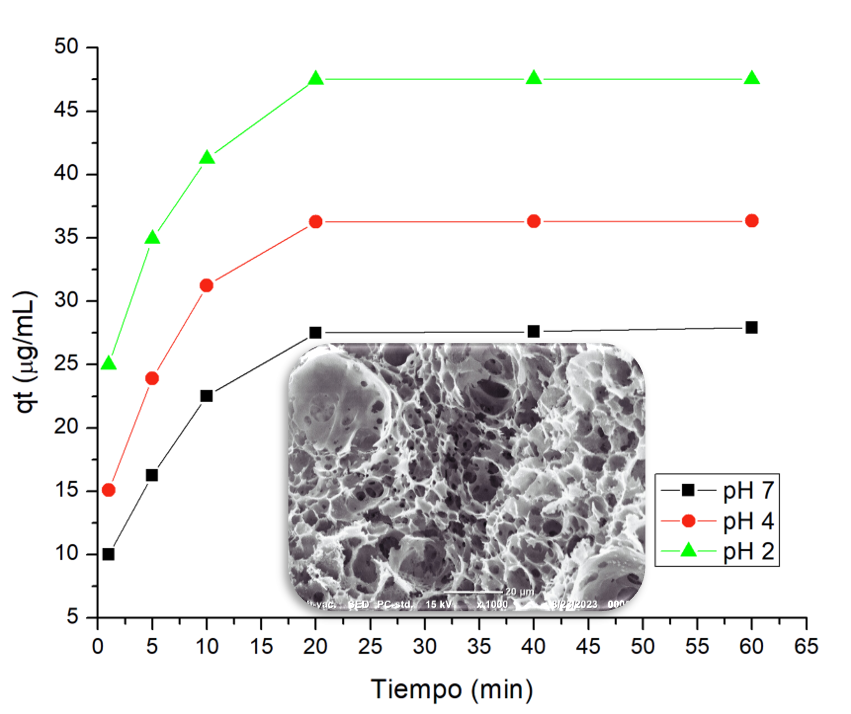
Los polímeros de impresión molecular (Molecularly Imprinted Polymers MIPs, por sus siglas en inglés) sintéticos han sido ampliamente estudiados para la remoción de contaminantes orgánicos presentes en aguas residuales. Sin embargo, su aplicación en la eliminación de metales pesados presentes en aguas subterráneas o en efluentes industriales ha sido limitada. En este trabajo se presenta la síntesis de un polímero MIP diseñado para la remoción selectiva de iones de arsénico trivalente As3+ en solución acuosa sintética. La plantilla de impresión molecular se preparó mediante la interacción del monómero vinilpiridina, EGDMA (dimetacrilato de etilenglicol) y arsenito de sodio en una mezcla acuosa-acetonitrilo. Las propiedades de adsorción se evaluaron a pH 2, 4 y 7. El polímero MIP mostró una mayor capacidad de remoción en comparación con el polímero sin impresión molecular. Finalmente, estos resultados indican que el uso del polímero MIP es una alternativa viable para el tratamiento de agua contaminada con arsénico trivalente.
Descargas
Referencias
M. S. Rahaman, M. M. Rahman, N. Mise, M. T. Sikder, G. Ichihara, M. K. Uddin, et al., “Environmental arsenic exposure and its contribution to human diseases, toxicity mechanism and management,” Environmental Pollution, vol. 289, pp. 117940-117956. 2021. https://doi.org/10.1016/j.envpol.2021.117940
M. M. Chaudhary, S. Hussain, C. Du, B. R. Conway, and M. U. Ghori, “Arsenic in Water: Understanding the Chemistry, Health Implications, Quantification and Removal Strategies,” Chemical Engineering, vol. 8, no. 4, pp. 78-126. 2024. https://doi.org/10.3390/chemengineering8040078
R. Zakhar, J. Derco, and F. Čacho, “An overview of main arsenic removal technologies,” Acta Chimica Slovaca, vol. 11, no. 2, pp. 107–113. 2018. https://doi.org/10.2478/acs-2018-0016
N. Ben Issa, V. N. Rajaković-Ognjanović, B. M. Jovanović, and L. V. Rajaković, “Determination of inorganic arsenic species in natural waters-Benefits of separation and preconcentration on ion exchange and hybrid resins,” Analytica Chimica Acta, vol. 673, no. 2, pp. 185–193, 2010. https://doi.org/10.1016/j.aca.2010.05.027
M. A. Barakat and S. Ismat-Shah, “Utilization of anion exchange resin Spectra/Gel for separation of arsenic from water,” Arabian Journal of Chemistry, vol. 6, no. 3, pp. 307–311, 2013. https://doi.org/10.1016/j.arabjc.2010.10.011
S. Karakurt, E. Pehlivan, and S. Karakurt, “Removal of Carcinogenic Arsenic from Drinking Water By the Application of Ion Exchange Resins,” Oncogen Journal, vol. 2, no. 1, pp. 5-13. 2019. https://doi.org/10.35702/onc.10005
H. Rahidul Hassan, “A review on different arsenic removal techniques used for decontamination of drinking water,” Environmental Pollutants and Bioavailability, vol. 35, no. 1, pp. 1-21. 2023. https://doi.org/10.1080/26395940.2023.2165964
P. Mahamallik and R. Swain, “A mini-review on arsenic remediation techniques from water and future trends,” Water Science Technology, vol. 87, no. 12, pp. 3108–3123, 2023. https://doi.org/10.2166/wst.2023.190
H. Govindappa, G. Abdi, U. T. Uthappa, G. Sriram, S. S. Han, and M. Kurkuri, “Efficient separation of arsenic species of oxyanion As (III) and As (V) by using effective polymer inclusion membranes (PIM),” Chemosphere, vol. 316, pp. 1-8 2023. https://doi.org/10.1016/j.chemosphere.2023.137851
J. D. Akoto et al., “Polyethyleneimine stabilized nanoscale zero-valent iron-magnetite (Fe3O4@nZVI-PEI) for the enhanced removal of arsenic from acidic aqueous solution: Performance and mechanisms,” Journal of Environmental Chemical Engineering, vol. 10, no. 6, pp. 1-11. 2022. https://doi.org/10.1016/j.jece.2022.108589
Y. Liu, Z. Chen, X. Yin, Y. Chen, Y. Liu, and W. Yang, “Selective and efficient removal of As(V) and As(III) from water by resin-based hydrated iron oxide,” Journal of Molecular Structure, vol. 1273, pp. 1-11 2023. https://doi.org/10.1016/j.molstruc.2022.134361
G. Wulff, “Fourty years of molecular imprinting in synthetic polymers: Origin, features and perspectives,” Microchimica Acta, vol. 180, no. 15–16. pp. 1359–1370, 2013. https://doi.org/10.1007/s00604-013-0992-9
J. J. Belbruno, “Molecularly Imprinted Polymers,” Chemical Reviews, vol. 119, no. 1, pp. 94–119, 2019. https://doi.org/10.1021/acs.chemrev.8b00171
T. Velempini, K. Pillay, X. Y. Mbianda, and O. A. Arotiba, “Epichlorohydrin crosslinked carboxymethyl cellulose-ethylenediamine imprinted polymer for the selective uptake of Cr(VI),” International Journal of Biological Macromolecules, vol. 101, pp. 837–844, 2017. https://doi.org/10.1016/j.ijbiomac.2017.03.048
M. Monier and N. H. Elsayed, “Selective extraction of uranyl ions using ion-imprinted chelating microspheres,” Journal of Colloid and Interface Science, vol. 423, pp. 113–122, 2014. https://doi.org/10.1016/j.jcis.2014.02.015
J. S. Mankar, M. D. Sharma, and R. J. Krupadam, “Molecularly imprinted nanoparticles (nanoMIPs): an efficient new adsorbent for removal of arsenic from water,” Journal of Materials Science, vol. 55, no. 16, pp. 6810–6825, 2020. https://doi.org/10.1007/s10853-020-04377-0
M. S. Jagirani et. al. “Preparation of novel arsenic-imprinted polymer for the selective extraction and enhanced adsorption of toxic As3+ ions from the aqueous environment,” Polymer Bulletin, vol. 77, no. 10, pp. 5261–5279, 2020. https://doi.org/10.1007/s00289-019-03008-2
H. B. Ahmad, G. E. Yasmin, S. A. Arain, I. A. Bhatti, and M. Hussain, “Synthesis of some novel adsorbents for antimicrobial activity and removal of arsenic from drinking water,” Korean Journal of Chemical Engineering, vol. 32, no. 4, pp. 661–666, 2015. https://doi.org/10.1007/s11814-014-0269-y
Abdullah et. al. “Ultrasonic mediated synthesis of arsenic imprinted polymer and their analytical practicality as a selective sorbent for removal of toxic As3+ ion from real samples,” Journal of Polymer Research, vol. 27, no. 9, pp. 28–30, 2020. https://doi.org/10.1007/s10965-020-02196-0
Descargas
Publicado
Número
Sección
Licencia
Derechos de autor 2025 Revista Ciencia Aplicada

Esta obra está bajo una licencia internacional Creative Commons Atribución-NoComercial-SinDerivadas 4.0.