Pasta cerámica de bajo costo para impresión 3D
DOI:
https://doi.org/10.66482/m15k1012Palabras clave:
impresión 3D, materiales cerámicos, extrusión DIW, resistencia mecánicaResumen
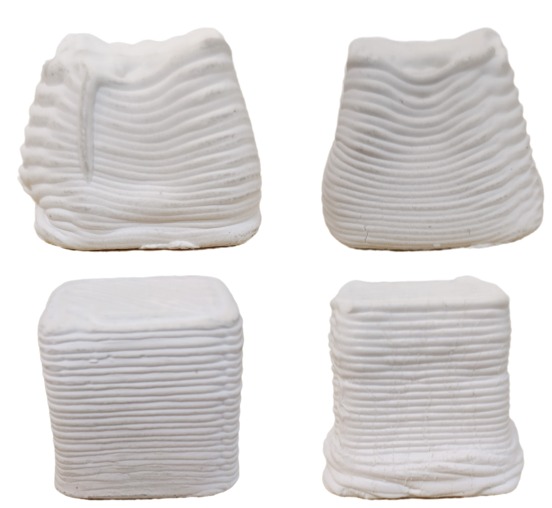
Los métodos de fabricación aditiva basados en la extrusión han surgido como una propuesta contemporánea para el desarrollo de nuevos materiales. En este trabajo se propone el desarrollo de una pasta cerámica para impresión 3D de bajo costo con materiales comerciales y de fácil acceso. Lo cual es una alternativa accesible para la manufactura aditiva cerámica en contextos académicos y de laboratorio. La pasta acrílica (Ready-Mix) es modificada mediante la adición de caolín y cemento blanco, para mejorar la resistencia mecánica y su comportamiento dinámico en procesos de extrusión. Se incorporó caolín (0–30%) y cemento blanco (10%). La formulación con 20% de caolín mostró la mejor relación entre estabilidad estructural y resistencia a la compresión (6.32 MPa a 35 días). Las piezas elaboradas tienen geometrías complejas con un acabado superficial homogéneo, lo cual demuestra la factibilidad de la propuesta.
Descargas
Referencias
S. V. Murphy and A. Atala, “3D bioprinting of tissues and organs,” Nature Biotechnology, vol. 32, no. 8, pp. 773–785, 2014. https://doi.org/10.1038/nbt.2958
N. Shahrubudin, T. C. Lee, and R. Ramlan, “An overview on 3D printing technology: Technological, materials, and applications,” Procedia Manufacturing, vol. 35, pp. 1286–1296, 2019. https://doi.org/10.1016/j.promfg.2019.06.089
T. D. Ngo, A. Kashani, G. Imbalzano, K. T. Q. Nguyen, and D. Hui, “Additive manufacturing (3D printing): A review of materials, methods, applications and challenges,” Composites Part B: Engineering, vol. 143, pp. 172–196, 2018. https://doi.org/10.1016/j.compositesb.2018.02.012
W. Xu et al., “Toward automated construction: The design-to-printing workflow for a robotic in-situ 3D printed house,” Case Studies in Construction Materials, vol. 17, pp. e01442, 2022. https://doi.org/10.1016/j.cscm.2022.e01442
C. W. Hull, “Apparatus for Production of Three-Dimensional object by stereolithography,” US Patent 4,575,330, Mar. 11, 1986.
R. Jones et al., “RepRap – the replicating rapid prototyper,” Robotica, vol. 29, no. 1, pp. 177–191, 2011. https://doi.org/10.1017/S026357471000069X
S. F. Iftekar, A. Aabid, A. Amir, and M. Baig, “Advancements and limitations in 3D printing materials and technologies: A critical review,” Polymers, vol. 15, no. 11, pp. 2519, 2023. https://doi.org/10.3390/polym15112519
C. Schelly, G. Anzalone, B. Wijnen, and J. M. Pearce, “Open-source 3-D printing technologies for education: Bringing additive manufacturing to the classroom,” Journal of Visual Languages & Computing, vol. 28, pp. 226–237, 2015. https://doi.org/10.1016/j.jvlc.2015.01.004
J. Jauk, H. Vašatko, L. Gosch, K. Ristoski, J. Füssl, and M. Stavric, “Coextrusion of Clay-Based Composites: Using a Multi-Material Approach to Achieve Gradient Porosity in 3D-Printed Ceramics,” Ceramics, vol. 6, no. 4, pp. 2243–2255, 2023. https://doi.org/10.3390/ceramics6040136
V. G. Rocha, E. Saiz, I. S. Tirichenko, and E. García-Tuñón, “Direct ink writing advances in multi-material structures for a sustainable future,” Journal of Materials Chemistry A, vol. 8, no. 31, pp. 15646–15657, 2020. https://doi.org/10.1039/D0TA04181E
Z. Chen et al., “3D printing of ceramics: A review,” Journal of the European Ceramic Society, vol. 39, no. 4, pp. 661–687, 2019. https://doi.org/10.1016/j.jeurceramsoc.2018.11.013
M. Z. Chaari, M. Abdelfatah, and C. Loreno, “A trial to convert a polymer FDM 3D printer to handle clay materials,” Springer Nature Applied Sciences, vol. 4, no. 3, pp. 68, 2022. https://doi.org/10.1007/s42452-022-04937-w
E. Romanczuk-Ruszuk, B. Sztorch, D. Pakuła, E. Gabriel, K. Nowak, and R. E. Przekop, “3D printing ceramics-materials for direct extrusion process,” Ceramics, vol. 6, no. 1, pp. 364–385, 2023. https://doi.org/10.3390/ceramics6010022
C. F. Revelo and H. A. Colorado, “3D printing of kaolinite clay ceramics using the Direct Ink Writing (DIW) technique,” Ceramics International, vol. 44, no. 5, pp. 5673–5682, 2018. https://doi.org/10.1016/j.ceramint.2017.12.219
E. Ordoñez, J. M. Gallego, and H. A. Colorado, “3D printing via the direct ink writing technique of ceramic pastes from typical formulations used in traditional ceramics industry,” Applied Clay Science, vol. 182, pp. 105285, 2019. https://doi.org/10.1016/j.clay.2019.105285
J. Alonso Madrid, G. Sotorrío Ortega, J. Gorostiza Carabaño, N. O. E. Olsson, and J. A. Tenorio Ríos, “3D claying: 3D printing and recycling clay,” Crystals, vol. 13, no. 3, pp. 375, 2023. https://doi.org/10.3390/cryst13030375
Panel Rey, “Compuesto ready mix estándar plus.” Accedido: Jul. 12, 2024. https://www.panelrey.com/Upload/Recursos/TDS-Compuestos-Estandar-PlusPR-MEX-pdf.pdf
Panel Rey, “Hoja de seguridad de materiales.” Accedido: Jul. 12, 2024. https://www.panelrey.com/Upload/Recursos/SDS-Compuestos-Convencional-MEX-pdf.pdf
Panel Rey, “Product declaration.” Accedido: Jul. 12, 2024. https://www.panelrey.com/Upload/Recursos/DWFC-EPD-JointCompound-MEX.pdf
I. Gibson, D. Rosen, and B. Stucker, Additive manufacturing technologies: 3D printing, rapid prototyping, and direct digital manufacturing. New York, NY: Springer, 2015. https://doi.org/10.1007/978-1-4939-2113-3
R. Hay, J. Li, and K. Celik, “Phase evolution, micromechanical properties, and morphology of calcium (alumino)silicate hydrates C-(A-)S-H under carbonation,” Cement and Concrete Research, vol. 152, pp. 106683, 2022. https://doi.org/10.1016/j.cemconres.2021.106683
Descargas
Publicado
Número
Sección
Licencia
Derechos de autor 2025 Revista Ciencia Aplicada

Esta obra está bajo una licencia internacional Creative Commons Atribución-NoComercial-SinDerivadas 4.0.